
editorial
What Makes a Subject Worth a Profile
Fame is not a reason. The pieces that endure are commissioned on a question rather than an occasion.

Most profiles are commissioned because someone has something to promote. That is the default engine of the form, and it produces a great deal of forgettable work — not because the subjects are uninteresting but because the occasion is doing the choosing.
The pieces that last are commissioned differently.
The occasion problem
A release date creates a window in which a subject is available and a publication has a hook. Everyone's incentives align, and the result is a piece organised around a thing being sold.
This is not automatically bad. Some excellent profiles have been produced inside promotional windows, usually because the writer found a question the promotion did not dictate.
But the default shape is predictable: the new project, the career so far, a personal detail, a forward-looking quote. Readers recognise it and it satisfies nobody.
Commissioning on a question
The alternative is to start with something genuinely unresolved about a person and pursue that.
Good questions tend to share features. They are specific rather than general — not what is this person like but why did someone with these options choose this. They are answerable, at least partly, through reporting. And they are questions the writer actually does not know the answer to, which is rarer than it sounds.
A profile built on a real question can survive a subject who gives little, because the piece has somewhere to go regardless. A profile built on an occasion collapses entirely if the interview is thin.
Mid-career is the fertile ground
The most productive moment is usually not the peak. Subjects at the height of success are heavily managed, have a settled narrative, and have the least to gain from candour.
More interesting are people mid-career: past the point where everything is possible, before the point where the story is fixed. They tend to have made choices they can now assess, including ones that did not work, and they are frequently more willing to discuss them.
People after a reversal are also more forthcoming than expected, though this requires care — a subject reflecting on a difficult period is exposed in ways that create obligations for the writer.
The people who are never profiled
The form skews heavily towards performers, because they are recognisable and available. This leaves the people who decide most of what gets made almost entirely uncovered.
Editors, cinematographers, casting directors, financiers and executives are rarely profiled, partly because they are less recognisable and partly because they have less incentive to participate. The result is a public account of the industry that systematically overrepresents its most visible layer.
The best editorial argument for profiling them is that they are frequently more candid, because they are less practised at managing coverage.
Why so few endure
The profiles that get reread years later tend to share one property: they were about something beyond their subject. A question about ambition, or work, or how someone survives public attention — with the subject as the specific case rather than the whole point.
That is difficult to commission and impossible to guarantee. But it is the difference between a piece that serves a release cycle and one worth the access it consumed.
More in Profiles
Profile
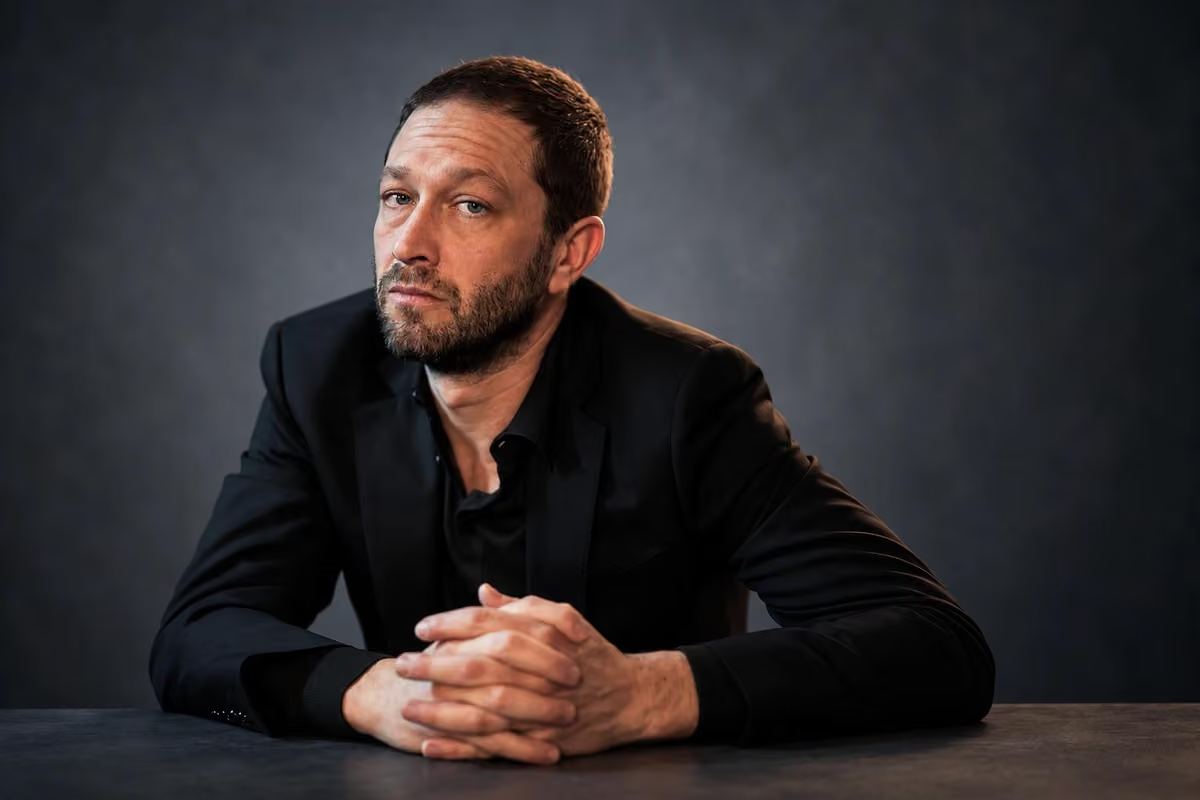
Ebon Moss-Bachrach Spent 20 Years as "That Guy." Then Came Cousin Richie.
The Bear has served its last plate. Its loudest cook, Ebon Moss-Bachrach, has spent 2026 on Broadway, writing his own episode and getting ready to return as Marvel's Thing.

Profile
How Samah Langner Moustafa Is Turning Finance Into a Growth Engine
The Group CFO of Go Behavioral and founder of Revnexa on scaling organizations with smarter financial strategy, strong governance and leadership that outlasts the quarter.