
Copyright
Why a 2017 Cheerleading Uniform Case Decides Which Parts of a Garment Qualify
Clothing is treated as a useful article under U.S. copyright law, but two-dimensional designs on garments can qualify under a two-part test set by the Supreme Court in 2017.
U.S. copyright covers original works of authorship, but the law treats everyday objects differently. A dress, a jacket or a costume has a practical purpose, and the Copyright Act sets that practical side apart from what can be protected.
The governing text is the statutory definition of a useful article in Title 17 of the U.S. Code. The leading case is a 2017 Supreme Court decision about cheerleading uniforms. Together they explain which parts of a garment can qualify and why fashion design has been left without explicit protection.
What the Copyright Act Says About Useful Articles
The Copyright Act defines a useful article as an article having an "intrinsic utilitarian function" that is not merely to portray the article's appearance or to convey information. Clothing fits that description.
Under the same definition, the design of a useful article is considered a pictorial, graphic or sculptural work only if, and only to the extent that, it incorporates pictorial, graphic or sculptural features. Those features must be identifiable separately from the article's utilitarian aspects and capable of existing independently of them.
The same category of protected works includes two-dimensional and three-dimensional works of fine, graphic and applied art.
The Congressional Research Service report on fashion design states that garments have traditionally been treated as useful articles, meaning basic necessities with utilitarian value, rather than as artistic creations. It says fashion design does not receive explicit protection under U.S. copyright law.
How Star Athletica Set the Two-Part Test
The Supreme Court decided Star Athletica v. Varsity Brands on March 22, 2017. The case came from the Sixth Circuit, which had reversed a district court's summary judgment for Star Athletica. Varsity and related entities hold more than 200 copyright registrations for two-dimensional designs of lines, chevrons and colorful shapes on cheerleading uniforms. The district court had held that the designs could not be conceptually or physically separated from the uniforms. The Supreme Court affirmed the Sixth Circuit.
Justice Clarence Thomas wrote the opinion of the Court, joined by Chief Justice Roberts and Justices Alito, Sotomayor and Kagan. Justice Ruth Bader Ginsburg concurred only in the judgment, agreeing with the result but not the reasoning. Justice Stephen Breyer dissented, joined by Justice Anthony Kennedy.
Under the Court's test, a feature incorporated into a useful article is eligible for protection only if it passes two steps. First, it must be perceivable as a two- or three-dimensional work of art separate from the useful article. Second, it must qualify as a protectable pictorial, graphic or sculptural work, on its own or fixed in another tangible medium, if imagined separately from the article. A useful article cannot qualify, and a replica of one gives no rights in the article itself.
The Court dropped the older split between physical and conceptual separability used by some lower courts. Physical separability asks whether a feature can be removed by ordinary means while the utilitarian aspects remain intact. The Court said that distinction was unnecessary, because separability does not require the useful article to remain after the artistic feature is imagined away.
The Court also addressed the argument that a feature is protectable only if the article would remain equally useful without it. The Government had argued for a test of whether the article would remain similarly useful. The Court found the debate unnecessary, because the inquiry focuses on the extracted feature. It cited Mazer v. Stein, which protected a statuette used as a lamp base, and said that requiring a solely artistic feature would undo that rule. It also declined to add two "objective" components the petitioner had proposed.
Eligible Is Not the Same as Copyrighted
The Court held that the cheerleading designs were separable and therefore eligible for copyright protection. It expressed no view on originality or the other prerequisites for a valid copyright, and it did not hold that the surface decorations are copyrightable.
The ruling is also narrow in scope. The only eligible feature is the two-dimensional artwork fixed in the uniform fabric. Varsity cannot prevent anyone from making a uniform with the same shape, cut and dimensions, and it can prohibit only reproduction of the surface designs. In a footnote, the Court said a shovel as a shovel could not be copyrighted, though a drawing of one could.
Justice Ginsburg would not have reached separability at all. In her view, the designs are standalone pictorial or graphic works that Varsity reproduced on uniforms. Justice Breyer agreed that a copyright cannot protect a useful article merely through a replica in another medium. He concluded that the designs fail the majority's test because, as submitted, they depict cheerleader uniforms.
The Copyright Office calls the separability test an "extremely limited" means of protecting designs of useful articles, according to the CRS report. The report says courts have excluded most industrial designs under the test.
According to the report, the Second Circuit held in Chosun, Int'l, Inc. v. Chrisha Creations, Ltd. (2005) that it is at least possible that elements of plush sculpted animal Halloween costumes are separable from the overall costume design and therefore eligible for copyright protection.
“The test is applied to each feature rather than to the garment as a whole.”
Why Fashion Design Bills Have Stalled
Congress has considered bills to give fashion designs their own protection. The Design Piracy Prohibition Act, H.R. 2196, was referred to the House Committee on the Judiciary in the 111th Congress and received no further legislative action.
The Innovative Design Protection and Piracy Prevention Act, S. 3728, was approved by the Senate Judiciary Committee by unanimous vote and reported to the Senate on December 6, 2010, according to the CRS report. The Senate did not vote on it before the 111th Congress ended.
Earlier bills followed the same path. H.R. 5055 in the 109th Congress was the subject of a hearing on July 27, 2006. In the 110th Congress, H.R. 2033 and S. 1957 were introduced, and neither passed. A hearing on H.R. 2033 and related matters was held February 14, 2008. None of these bills became law.
In hearing testimony, the Copyright Office praised proponents for seeking a modest term of protection suited to fashion design.
The Office also warned that a two-year registration window would make registration a relatively meaningless formality for a design protected for only three years.
Reading a Garment Feature by Feature
The test is applied to each feature rather than to the garment as a whole. A single item can contain elements that are separable and elements that are not, and each is assessed on its own. One element of a piece can therefore qualify while another does not.
For surface designs, the CRS report says both bills would have protected the appearance of apparel and its ornamentation. Both also would have provided that the presence or absence of a particular color, or of a pictorial or graphic work imprinted on fabric, would not be considered in determining originality or infringement.
Trademark is another route. According to the CRS report, trade dress can protect a fashion design if it has gained consumer recognition as identifying a particular source, citing Samara Bros. v. Wal-Mart Stores, 529 U.S. 205 (2000). The Copyright Office noted that trademark covers only configurations that identify source, and only against uses that create a substantial likelihood of customer confusion.
Design patents could also be a potential means, according to the CRS report, though the Copyright Office noted they are difficult and expensive to obtain and involve a lengthy examination process.
More in Style
Tariffs
What a February Supreme Court Ruling and July 24 Section 301 Duties Mean for Imported Fabric
A February Supreme Court ruling, open refund questions and July 24 Section 301 duties now set what imported fabric and garments cost at the U.S. border.
Fashion Collaborations
Marimekko's Popkorni Print Comes to Two Veja Sneaker Models, on Sale From Nov. 12
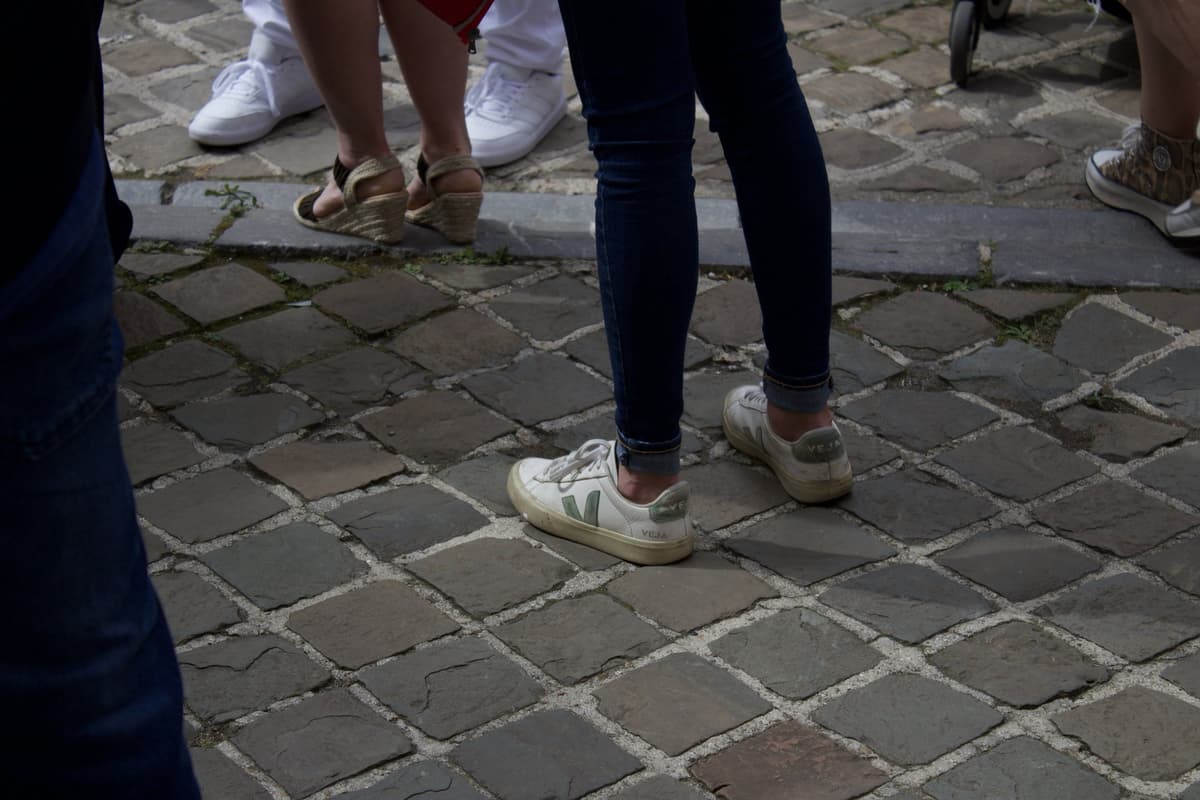
Marimekko's Popkorni print appears on two Veja sneaker models, available from 12 November 2026 per the companies' September release and later trade reports.
- Loewe Sets Nov. 12 Launch for Disney and Tim Burton Nightmare Before Christmas Line
- How FTC Endorsement Rules Apply When a Designer Lends or Gifts a Look
- Capri Raises Full-Year Outlook as Jimmy Choo Grows and Michael Kors Falls
- Monique Lester's Lingerie Brand, Crystal Rose Intimates, Launches 17 November